
 Precious waterways: how contaminated mountain streams could power American-made technology
Dear Latrice,
We also love...
 James | Colorado Springs, CO
That's why researchers at CU Boulder are digging into geochemistry to clean Colorado's water and use the contaminants for good.
Campus Location
 Boulder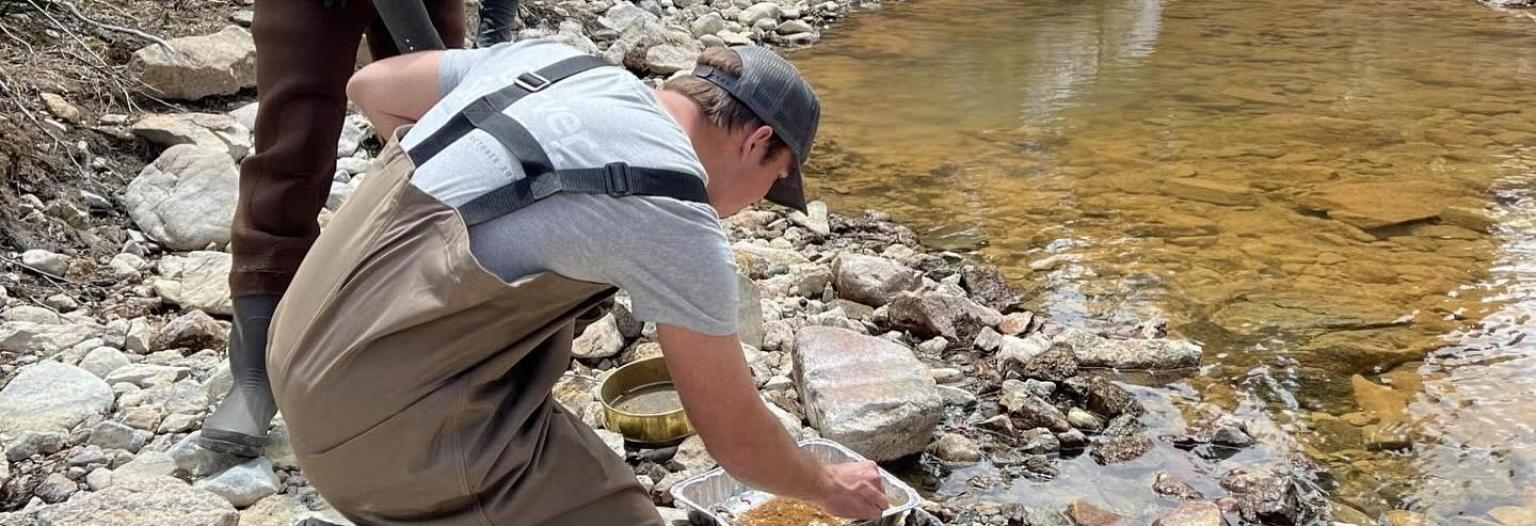
Neodymium may not be a household name, but the heavy metal powerhouse helps power many of your everyday devices like phones and computers. In Colorado, these elements appear in unexpectedly high concentrations in mountain streams along the state’s mineral belt where acidic water interacts with metal-rich bedrock, especially near abandoned mines and natural acid rock deposits.
For more than a decade, CU professors Tom Marchitto and Diane McKnight have studied these contaminated waterways, originally focusing on metals like copper and zinc. That work has now taken on new significance, with McKnight and Marchitto becoming part of a $2.8 million U.S. Department of Energy–funded project, led by the University of Missouri, aimed at extracting rare earth elements from acid rock drainage. The timing is strategic: the U.S. is seeking to reduce dependence on China for rare earth elements, while Colorado faces worsening metal pollution as warming temperatures thaw previously frozen, acid-producing rock. “If there’s a valuable commodity that could be recovered through that process, it could change the equation,” McKnight said, noting that cleaning contaminated water is typically costly.
The discovery of rare earths in these waters occurred accidentally, when a student’s water samples were tested for rare earth elements, revealing “200 micrograms per liter of neodymium,” a surprisingly high amount. Since then, students and researchers have continued tracking rising concentrations that can damage ecosystems, as seen recently when hundreds of dead fish washed up on the shore of a Colorado mountain lake.
At the University of Missouri, researchers Baolin Deng and Pan Ni are developing a selective extraction method using ion-imprinted polymers made from seafood waste. Designed at the molecular scale, these polymers are meant to isolate nearly identical rare earth elements with precision. As Ni put it, “These elements are like twin brothers… it’s incredibly challenging to differentiate them.”
Meanwhile, the Colorado team is identifying potential extraction sites and digging deeper into the underlying geochemistry. “Knowing more about the fundamentals,” Marchitto said, “will inform what kind of recovery efforts can be used. It’s all connected.”